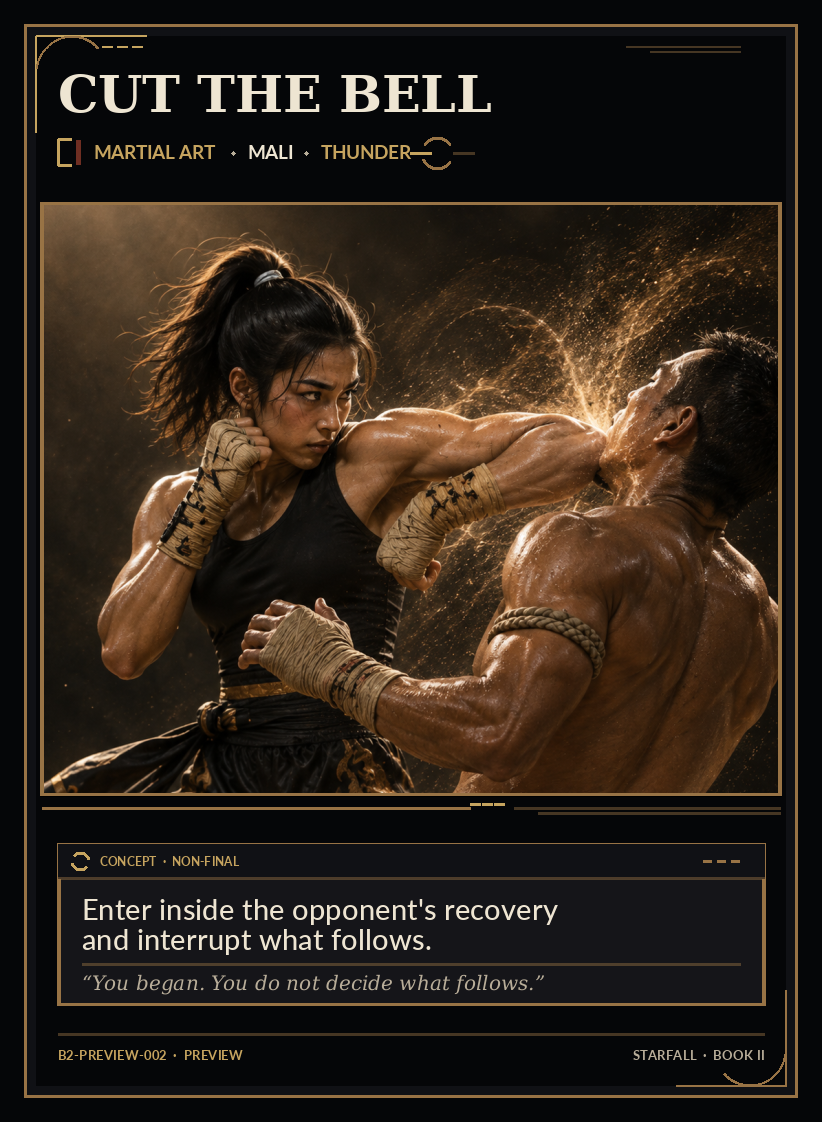
PREVIEW — IN DEVELOPMENT. Cut the Bell is the second revealed Martial Art for Mali in Starfall Catastrophe Book II: The Martial Age. It is a concept preview, not a final mechanical card. Values, costs, timing language, and production rules have not been assigned.
Mali’s first preview, Take the Beat, begins with distance. An opponent commits to moving forward. Mali reads the transfer of weight, sends a lead push kick into the entry, and interrupts the attack before its rhythm can settle. It is a clean statement of her relationship with Thunder: she sees the beginning and acts before the next person can claim it.
But a fighting path cannot exist only in its ideal range. What happens when Mali is not early enough to keep the opponent away? What happens when the first action is already present, the distance has collapsed, and the exchange is happening around her?
Inside the recovery
Cut the Bell begins there. The opponent has already entered behind a committed punch. Mali receives that line on a compact cover, steps into the protected inside space, and turns a short elbow through the interval before the opponent can recover their guard or continue the sequence.
The answer is not retreat. It is also not a second version of Take the Beat with a different striking limb. Take the Beat denies the entry and creates room. Cut the Bell accepts that the entry happened. Mali moves closer, takes responsibility for the dangerous space, and interrupts what was supposed to follow.
That distinction matters to her character. Take the Beat says, “I see you beginning.” Cut the Bell says, “You began. You do not decide what follows.” The first line is about anticipation. The second is about control after events are already in motion. It reveals that Mali is not only effective when she arrives early. She can find agency after the moment she wanted to prevent has passed.
A real close-range foundation
The physical foundation is contemporary Muay Thai: balanced close-range structure, a responsible guard, a covered entry, coordinated rotation through the feet, hips, torso, and shoulder, and a compact elbow that does not need to reach across open distance. Elbows belong to Muay Thai’s close-range vocabulary, including exchanges around punching and clinch distance.
This article is not instruction. A still image cannot teach the stance relationship, defensive choices, target selection, or safe practice required to perform an elbow. The final two-person choreography must remain accountable to qualified Muay Thai practitioners. The preview uses plain English rather than attaching an unverified Thai name or claiming that this exact sequence represents one universal school method.
The image also stops at the controlled instant of contact rather than turning the elbow’s consequences into spectacle. Mali’s face, cover, planted structure, opponent interaction, and compact trajectory carry the scene. Precision matters more than injury.
Thunder without lightning
Thunder still means Tempo. There are no bolts, electrical arcs, or supernatural damage effects. The restrained bronze displacement records timing: sweat and cloth continue along the opponent’s first action while Mali occupies the recovery beat. The effect does not make the elbow credible. It makes the interval visible.
This was also an important test for the approved Book II Martial Art frame. Take the Beat uses open space and a long horizontal action. Cut the Bell compresses two bodies, several guard lines, and an elbow into close range. Both use the same frozen frame, artwork aperture, hierarchy, typography, Gate geometry, rules region, and footer. The frame did not move to accommodate the new card.
That is how a catalog begins to become a fighting path rather than a sequence of isolated reveals. One frame can hold two distinct decisions. One character can answer two different moments.
“You began. You do not decide what follows.”
CUT THE BELL · MALI — THUNDER · MARTIAL ART · B2-PREVIEW-002
PREVIEW — IN DEVELOPMENT. This preview contains conceptual direction only. It does not establish final mechanics, balance, card values, or production rules.